

BTS RF Combining & Distribution Solution
Multi-Band and Multi-Operator RF Integration for DAS and Wireless Networks
Modern wireless coverage systems often need to integrate RF signals from multiple base stations, operators and frequency bands into a common distribution network.
When multiple BTS sources share a DAS or RF distribution infrastructure, proper signal combining, filtering, isolation and distribution are essential for maintaining reliable RF performance.
Lenolink provides BTS RF combining and distribution solutions for DAS and wireless coverage systems, including Point of Interface (POI) units, multi-band combiners, RF filters, hybrid combiners, splitters, couplers and other passive RF components.
Solutions can be configured according to the required frequency bands, RF power levels, number of BTS inputs, output architecture, connector requirements and project application.
BTS RF Integration Challenges
Integrating multiple BTS sources into a common RF distribution system requires careful consideration of the RF architecture and component performance.
Typical project requirements include:
- Multiple BTS signal combining
- Multi-band RF integration
- Multi-operator signal integration
- Uplink and downlink filtering
- RF isolation between different signal paths
- Insertion loss control
- Passive intermodulation (PIM) performance
- RF power handling
- VSWR control
- RF signal distribution
- Multiple DAS coverage zones
- Compact equipment-room or rack-mounted installation
Lenolink provides RF interface and passive distribution components designed to support these requirements in DAS and wireless coverage systems.
BTS RF Solution Architecture
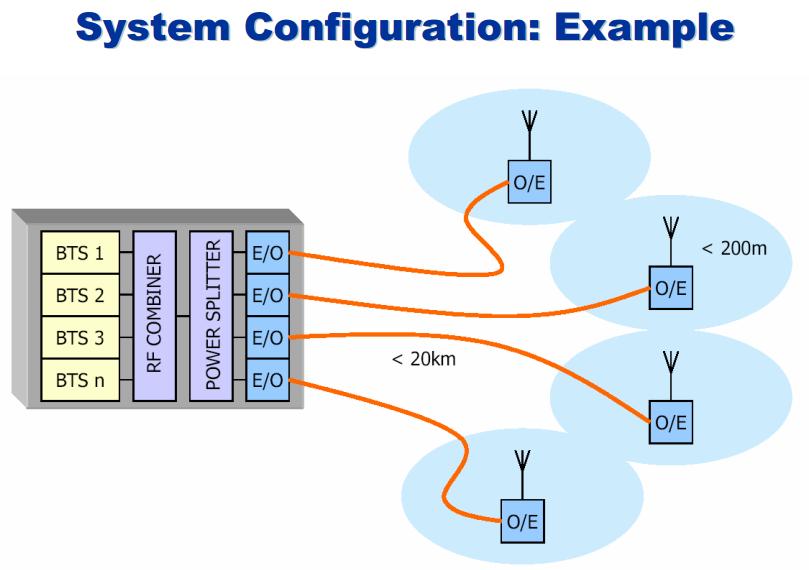
A typical BTS-fed DAS system combines RF signals from multiple BTS sources before distributing them through a common RF infrastructure.
Typical RF Signal Path
BTS / Base Stations
↓
POI / RF Combining
↓
RF Filtering & Band Isolation
↓
Common DAS RF Interface
↓
Splitters / Couplers / Tappers
↓
DAS Antennas
↓
Indoor Coverage Areas
The exact architecture depends on the number of operators, frequency bands, RF power levels, coverage areas and DAS configuration.
1. Point of Interface (POI)
Multi-Operator and Multi-Band BTS Interface
A Point of Interface (POI) provides an RF interface between multiple BTS sources and a common DAS or RF distribution system.
The POI can combine RF signals from different BTS inputs and frequency bands into a controlled common RF output path. Depending on the system configuration, integrated filtering and frequency-selective RF paths can be used to maintain separation between different signal bands.
Lenolink POI solutions are suitable for applications requiring:
- Multiple BTS inputs
- Multi-operator RF integration
- Multi-band signal combining
- Uplink and downlink RF paths
- Controlled RF isolation
- High-power RF handling
- Low-PIM RF infrastructure
Typical POI Configuration
| RF Source | Function |
|---|---|
| BTS / Operator A | RF signal input |
| BTS / Operator B | RF signal input |
| BTS / Operator C | RF signal input |
| BTS / Operator D | RF signal input |
| POI | RF combining and filtering |
| DAS | Common RF distribution |
| Splitters / Couplers | RF signal distribution |
| DAS Antennas | Wireless coverage |
The number of inputs, frequency configuration and output architecture can be selected according to project requirements.
2. Multi-Band RF Combining
Integrating Multiple Frequency Bands into a Common RF Path
Different cellular systems may operate on different frequency bands. A multi-band RF combiner allows signals from selected frequency ranges to be integrated into a common RF distribution path.
Lenolink provides several RF combining configurations for different system requirements.
Available RF Combining Solutions
Dual-Band Combiner
Combines two specified frequency bands into a common RF path.
Triple-Band Combiner
Combines three frequency bands for multi-band cellular distribution systems.
Quad-Band Combiner
Integrates four frequency bands into a common RF interface.
Quint-Band Combiner
Provides RF combining for five specified frequency bands.
Hybrid Combiner
Provides balanced RF combining and signal distribution where hybrid coupling is required.
The appropriate configuration depends on the required frequency bands, insertion loss, isolation, PIM performance and RF power level.
3. RF Filtering & Band Isolation
Frequency-Selective RF Signal Management
In multi-band BTS systems, RF filtering is important for maintaining separation between different frequency bands and controlling unwanted out-of-band signals.
Lenolink provides RF filters and related frequency-selective components for applications requiring:
- Band separation
- Uplink and downlink filtering
- Out-of-band rejection
- Frequency-specific RF conditioning
- Multi-band RF integration
- RF interference control
RF filters can be integrated into POI assemblies or used as individual components according to the system architecture.
4. RF Signal Distribution
From BTS RF Interface to Distributed Antenna Systems
After BTS signals are combined, the common RF signal needs to be distributed throughout the DAS or antenna network.
Lenolink provides passive RF distribution components for different distribution architectures.
Typical components include:
- RF Power Splitters
- Directional Couplers
- Tappers
- Hybrid Combiners
- RF Cables
- RF Connectors
- Adapters
- Other Passive RF Components
These components can be combined to create RF distribution networks serving multiple floors, zones or antenna branches.
The distribution architecture should be designed according to the RF power budget, cable losses, splitting ratios, coverage requirements and number of antenna branches.
5. Low-PIM RF Infrastructure
Designed for High-Performance Wireless Networks
Passive intermodulation (PIM) can affect RF system performance, particularly in multi-band and high-power wireless infrastructure.
Lenolink offers low-PIM RF passive components for applications where PIM performance, VSWR, isolation and RF power handling are important considerations.
Typical low-PIM components include:
- POI
- RF Combiners
- Hybrid Combiners
- RF Filters
- Splitters
- Couplers
- Tappers
- RF Dummy Loads
Low-PIM performance depends not only on individual RF components, but also on connectors, cables, installation quality, mechanical interfaces and the overall RF system.
Typical BTS Solution Applications
Lenolink BTS RF combining and distribution solutions can be used in a range of wireless infrastructure applications.
Multi-Operator DAS
Combine RF signals from multiple operators into a shared DAS infrastructure.
Multi-Band Cellular Networks
Integrate multiple cellular frequency bands into a common RF distribution system.
Large Indoor Venues
Typical applications include:
- Shopping malls
- Airports
- Railway stations
- Stadiums
- Convention centers
- Hotels
- Large office buildings
- Transportation facilities
Enterprise Wireless Networks
Suitable for enterprise and private wireless infrastructure requiring controlled RF integration and distribution.
Complex RF Distribution Systems
For projects with multiple frequency bands, multiple BTS sources and multiple RF distribution branches, Lenolink components can be configured as part of an integrated RF distribution architecture.
How to Select a BTS RF Solution
The appropriate BTS RF solution depends on the number of BTS sources, frequency bands, RF power, required isolation and the downstream DAS architecture.
| Project Requirement | Recommended Solution |
|---|---|
| Multiple BTS inputs | POI / Multi-Band Combiner |
| Multiple operators | Multi-Operator POI |
| Two frequency bands | Dual-Band Combiner |
| Three frequency bands | Triple-Band Combiner |
| Four frequency bands | Quad-Band Combiner |
| Five frequency bands | Quint-Band Combiner |
| Uplink / downlink separation | Duplexer / RF Filter |
| RF power distribution | Splitter / Coupler / Tapper |
| High RF power | High-Power RF Components |
| Low-PIM requirement | Low-PIM RF Components |
| Multiple DAS zones | Splitter / Coupler Distribution Network |
Note: The recommended RF configuration should be determined according to the RF conditions, BTS output power, frequency bands, number of operators, DAS architecture, RF loss budget and applicable regulatory or operator requirements.
RF Engineering Information Required
To evaluate a BTS RF combining or distribution project, Lenolink recommends providing the following information:
1. BTS Information
- Number of BTS sources
- Operator or wireless system
- Number of sectors
- RF output power per port
2. Frequency Information
- Operating frequency bands
- Uplink frequencies
- Downlink frequencies
- Required bandwidth
3. RF Architecture
- Number of RF inputs
- Number of RF outputs
- DAS configuration
- Number of coverage zones
- Splitter / coupler requirements
4. Performance Requirements
- Required insertion loss
- Required isolation
- VSWR requirement
- PIM requirement
- RF power handling
5. Mechanical Requirements
- Rack-mounted or standalone installation
- Available installation space
- Connector type
- Cable interface
- Indoor or outdoor installation environment
Providing these details allows the RF configuration to be evaluated more efficiently and helps determine the appropriate combination of POI, combiners, filters and distribution components.
Customized BTS RF Interface Solutions
RF Components Configured for Your Application
Different BTS and DAS projects can have significantly different RF requirements.
Lenolink can provide RF interface and passive component configurations based on project-specific requirements such as:
- Frequency bands
- RF power levels
- Number of RF ports
- Input and output configuration
- RF isolation
- PIM requirements
- Connector configuration
- Mechanical dimensions
- Rack-mounted installation
- System architecture
Customized solutions may include:
- Custom POI configurations
- Multi-band RF combiners
- Frequency-selective filters
- Custom RF port configurations
- High-power RF components
- Rack-mounted RF assemblies
- Customized connector configurations
- Custom mechanical enclosures
Our RF engineering team can review the project requirements and recommend a suitable RF combining and distribution configuration.
Related RF Products
Lenolink BTS RF solutions can be built from a range of RF and microwave components.
POI
Point of Interface units for multi-operator and multi-band RF integration.
RF Combiners
Dual-band, triple-band, quad-band, quint-band and hybrid RF combiners.
RF Filters
Frequency-selective filters for band separation and RF signal conditioning.
Splitters & Couplers
Passive RF distribution components for multi-branch DAS architectures.
RF Dummy Loads
High-power RF termination solutions for testing, commissioning and RF infrastructure.
RF Connectors & Accessories
RF interface components for reliable installation and system integration.
BTS RF Solution Design Process
From RF Requirements to System Configuration
Lenolink follows a practical engineering approach to BTS RF solution development.
Step 1 — Project Requirements
Provide the required frequency bands, RF power, BTS inputs, outputs and application information.
Step 2 — RF Architecture Review
Our engineering team reviews the required RF signal paths, combining configuration, filtering requirements and distribution architecture.
Step 3 — Component Selection
Suitable POI, combiners, filters, splitters, couplers and other RF components are selected according to the system requirements.
Step 4 — RF Performance Evaluation
Key parameters such as insertion loss, isolation, VSWR, PIM and power handling are evaluated according to the project requirements.
Step 5 — Configuration & Production
The confirmed RF configuration and mechanical requirements are used for product configuration and production.
Step 6 — Technical Support
Lenolink provides technical documentation and support for installation, commissioning and troubleshooting according to the project requirements.
Why Choose Lenolink?
RF Components Designed Around Your System
Lenolink focuses on RF and microwave components for wireless coverage and RF distribution applications.
Multi-Band RF Expertise
Solutions can cover multiple cellular frequency bands and different RF combining configurations.
Integrated RF Component Portfolio
POI, combiners, filters, splitters, couplers, dummy loads and other passive RF components can be integrated into a complete RF interface solution.
Low-PIM Options
Low-PIM components are available for applications where passive intermodulation performance is important.
Flexible RF Configuration
Port configuration, frequency bands, RF power and mechanical requirements can be evaluated according to project requirements.
Engineering Support
Lenolink provides technical assistance for product selection, RF configuration, documentation and project-specific requirements.
Frequently Asked Questions
What is a BTS RF combining solution?
A BTS RF combining solution integrates RF signals from multiple BTS sources or frequency bands into a common RF interface for a DAS or other RF distribution system.
What is a POI in a DAS system?
A Point of Interface (POI) is an RF interface used to combine and manage signals from multiple BTS sources before they are distributed through a common DAS infrastructure.
When is a multi-band combiner required?
A multi-band combiner is typically used when multiple frequency bands need to share a common RF distribution path.
What is the difference between a POI and a standard RF combiner?
A standard RF combiner generally combines specified RF inputs into a common output. A POI is typically a more integrated RF interface that can incorporate multiple inputs, frequency-selective paths and filtering according to the DAS architecture.
Why is RF isolation important?
Adequate RF isolation helps reduce unwanted interaction between different RF signal paths and supports stable operation of multi-band and multi-operator systems.
Why is PIM important in BTS and DAS systems?
Passive intermodulation can generate unwanted RF products when high-power RF signals pass through passive components and connections. Low-PIM components and proper installation practices are therefore important in many cellular infrastructure applications.
Can Lenolink provide customized BTS RF configurations?
Yes. RF configurations can be evaluated according to frequency bands, RF power, port configuration, isolation, PIM requirements, connector type and mechanical requirements.
What information should I provide for an RF solution inquiry?
At minimum, provide the required frequency bands, BTS output power, number of RF inputs and outputs, connector requirements and application information. Additional DAS architecture and RF performance requirements are helpful for engineering evaluation.
Need a BTS RF Combining Solution?
Whether you need a multi-operator POI, multi-band RF combiner, RF filter or passive RF distribution network, Lenolink can help evaluate the required RF configuration according to your project requirements.
Send us your:
Frequency Bands + BTS Power + Number of Inputs + Number of Outputs + Connector Type
Our RF engineering team can review your requirements and recommend a suitable BTS RF combining and distribution solution.