

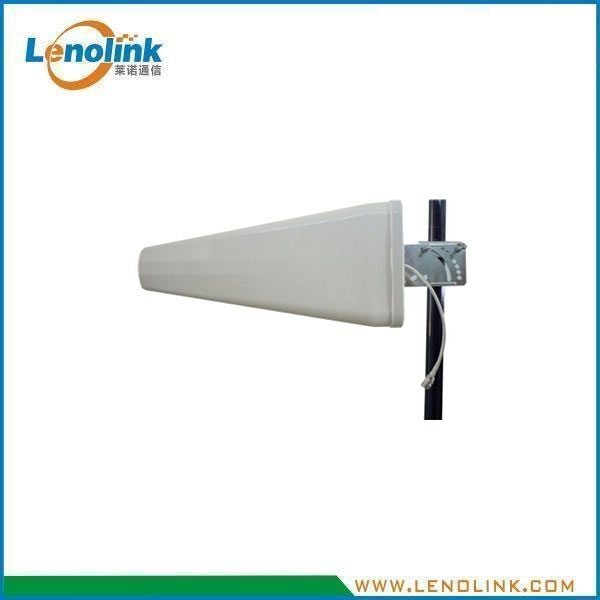
617–4200 MHz Wideband Log Periodic Antenna
Product Model: LC-AR617-4200V09i60B-4310F
Indoor/Outdoor Wideband Directional Antenna for LTE, 5G and Cellular Coverage
Wideband Directional Antenna for Cellular, DAS and RF Coverage Systems
Product Summary
The Lenolink LC-AR617-4200V09i60B-4310F Wideband Log Periodic Antenna is a directional broadband antenna designed for cellular and wireless communication coverage applications from 617 MHz to 4200 MHz.
The antenna provides a specified gain of 7.5 ± 1 dBi at 617–960 MHz and 9 ± 1 dBi at 1710–2700 MHz and 3300–4200 MHz.
The antenna features vertical polarization, low VSWR, directional radiation characteristics and a compact mechanical design.
It is suitable for RF distribution and coverage applications where a wide frequency range and directional radiation pattern are required.
Applications
Wideband Cellular and Wireless Coverage
Typical applications include:
- LTE coverage systems
- 5G sub-6 GHz coverage systems
- Indoor DAS
- Outdoor wireless coverage
- Cellular repeater systems
- Distributed antenna systems
- RF signal distribution
- Public communication networks
- Transportation facilities
- Railway and metro systems
- Airports
- Industrial facilities
- Large buildings
- Warehouses
- Campuses
- RF shadow areas
- Wireless infrastructure testing
Key Specifications
| Electrical Specifications | ||||||
| Item No. | LC-AR617-4200V09i60B-4310F | |||||
| Frequency Range | MHz | 617-806 | 806-960 | 1710-2700 | 3300-4200 | |
| Gain | dBi | 7.5±1 | 7.5±1 | 9±1 | 9±1 | |
| Polarization | Vertical | |||||
| Beam width | Horizontal | deg | 95±15 | 95±15 | 75±15 | 75±10 |
| Vertical | 65±10 | 65±10 | 55±15 | 55±15 | ||
| VSWR | ≤1.8 | ≤1.8 | ≤1.6 | ≤1.6 | ||
| Front-To-Back Ratio | dB | 10 | 18 | 20 | 15 | |
| PIM, 3rd Order, 2 x 2W, | dBc | ≤-153 | ||||
| Maximum input power | W | 50 | ||||
| Lightning protection | DC Ground | |||||
| Impedance | Ω | 50 | ||||
| Mechanical Specification | ||||||
| Connector Type | 4.3-10 Female | |||||
| Connector position | Bottom | |||||
| Size | (mm) | 440×210×65 | ||||
| Antenna Weight | kg | 0.54 | ||||
| Operational Temperature | oC | -40~55 | ||||
| Radome material | ABS, White, RAL9003 | |||||
| Mounting hardware | (mm) | φ35~φ50 | ||||
Key Features
- Wide frequency coverage from 617 to 4200 MHz
- Log periodic directional antenna design
- Multi-band cellular coverage capability
- 617–806 MHz / 806–960 MHz operation
- 1710–2700 MHz operation
- 3300–4200 MHz operation
- Gain up to 9 ± 1 dBi in the specified high-frequency bands
- Vertical polarization
- Low VSWR
- Directional radiation pattern
- Third-order PIM of −153 dBc @ 2 × 2 W
- 50 W maximum input power
- DC-grounded lightning protection
- Compact 440 × 210 × 65 mm design
- Lightweight 0.54 kg construction
- Bottom RF connector
- Ø35–Ø50 mm mounting hardware
- −40°C to +55°C operating temperature
- ABS radome
- Suitable for indoor and suitable outdoor RF applications
- Wideband directional log periodic antenna
Technical Advantages
1. Wide 617–4200 MHz Frequency Coverage
The antenna provides broad frequency coverage from:
617 MHz to 4200 MHz
This allows multiple cellular frequency ranges to be supported by a single antenna design.
2. Multi-Band Cellular Compatibility
The antenna covers four specified frequency ranges:
617–806 MHz
806–960 MHz
1710–2700 MHz
3300–4200 MHz
This makes it suitable for multi-band RF coverage systems where several cellular bands need to be distributed through a common antenna infrastructure.
3. Directional Log Periodic Design
The log periodic antenna structure provides directional radiation characteristics across a wide frequency range.
This makes the antenna suitable for applications where RF energy needs to be concentrated toward a specific coverage area.
4. Specified Gain Across Multiple Frequency Bands
The antenna provides a specified gain of 7.5 ± 1 dBi in the 617–960 MHz range and 9 ± 1 dBi in the 1710–2700 MHz and 3300–4200 MHz ranges.
5. Low VSWR Across the Specified Bands
The specified VSWR is ≤1.8 at 617–960 MHz and ≤1.6 at 1710–4200 MHz.
6. Low-PIM Performance
The specified third-order PIM is:
−153 dBc @ 2 × 2 W
Low PIM performance is particularly valuable in multi-band cellular RF systems where passive intermodulation can affect receiver performance.
7. Compact and Lightweight Design
Dimensions:
440 × 210 × 65 mm
Weight:
0.54 kg
The compact and lightweight construction simplifies installation on poles, brackets and other RF mounting structures.
Working Principle
How Does a Log Periodic Antenna Work?
A log periodic antenna uses a series of radiating elements with different lengths and spacing to provide broadband directional RF performance.
The antenna receives RF signals from a connected wireless communication system and radiates them toward the intended coverage area.
In the transmit direction:
RF Equipment → Feeder Cable → Log Periodic Antenna → Coverage Area
In the receive direction:
Coverage Area → Log Periodic Antenna → Feeder Cable → RF Equipment
Because the antenna covers a wide frequency range, one antenna can support multiple cellular frequency bands within its specified operating range.
The antenna itself does not perform RF amplification or optical conversion; it functions as the RF radiating element at the end of the distribution system.
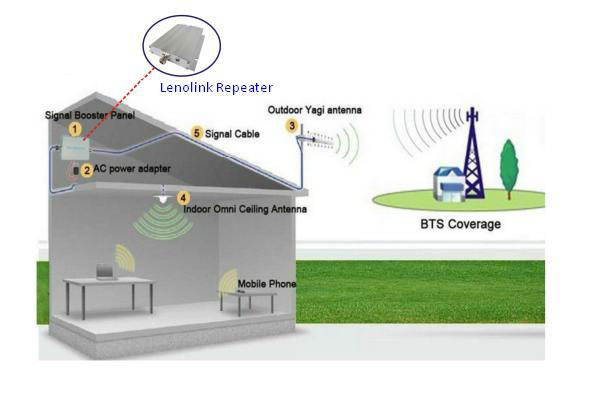
Applications in DAS and Repeater Systems
The LC-AR617-4200V09i60B-4310F can be integrated into various RF coverage architectures, including:
Base Station → Repeater / DAS → Feeder Cable → Log Periodic Antenna → Coverage Area
For fiber-optic distributed coverage:
BTS → MU → Optical Fiber → RU → RF Distribution → Antenna
The wide frequency range allows the antenna to support multiple cellular bands within the specified frequency coverage.
Why Choose Lenolink Wideband Log Periodic Antenna?
Wideband RF Coverage
Coverage from 617 to 4200 MHz allows one antenna design to support multiple cellular frequency ranges.
Multi-Band System Integration
The antenna can be integrated with:
- DAS systems
- Fiber-optic repeaters
- RF repeaters
- RF distribution systems
- Cellular coverage systems
Directional RF Performance
The log periodic structure provides directional radiation characteristics for targeted RF coverage.
Low-PIM Design
The specified PIM performance of −153 dBc @ 2 × 2 W supports demanding multi-band cellular RF environments.
Easy Installation
The compact and lightweight design, together with the specified mounting hardware, simplifies installation.
Frequently Asked Questions
Q1: What is a wideband log periodic antenna?
A wideband log periodic antenna is a directional antenna designed to provide broadband RF performance across a wide frequency range.
Q2: What frequency range does this antenna support?
The specified frequency range is:
617–4200 MHz
Q3: What cellular bands are covered?
The antenna covers:
- 617–806 MHz
- 806–960 MHz
- 1710–2700 MHz
- 3300–4200 MHz
Q4: What is the antenna gain?
The specified gain is:
- 7.5 ± 1 dBi at 617–960 MHz
- 9 ± 1 dBi at 1710–4200 MHz
Q5: What is the polarization?
The antenna uses:
Vertical polarization.
Q6: What is the VSWR?
The specified VSWR is ≤1.8 at 617–960 MHz and ≤1.6 at 1710–4200 MHz.
Q7: What is the maximum input power?
The maximum specified input power is:
50 W
Q8: What connector is used?
The supplied specification identifies:
4.3-10 Female
Q9: Is the antenna suitable for DAS systems?
Yes. Its wide frequency coverage makes it suitable for integration into specified multi-band DAS and RF distribution architectures.
Q10: Is the antenna suitable for outdoor applications?
The supplied specification identifies indoor/outdoor use and an operating temperature of −40°C to +55°C. However, no IP rating is specified in the supplied data, so outdoor installation should be evaluated according to the actual environmental conditions and installation requirements.
Q11: What is the antenna size?
440 × 210 × 65 mm
Q12: What is the antenna weight?
0.54 kg
Q13: What mounting diameter is supported?
The specified mounting hardware supports:
Ø35–Ø50 mm
Q14: What is the PIM performance?
The supplied specification lists:
Third-order PIM: −153 dBc @ 2 × 2 W
Custom Antenna Engineering Support
Lenolink can evaluate antenna requirements according to:
- Frequency range
- Gain
- Beamwidth
- Polarization
- Connector
- Mounting method
- Indoor/outdoor installation
- RF coverage architecture
Lenolink RF engineers can evaluate the project requirements and provide a customized Multi-Band Fiber Optical Digital Repeater Solution.
Contact: info@lenolink.com