

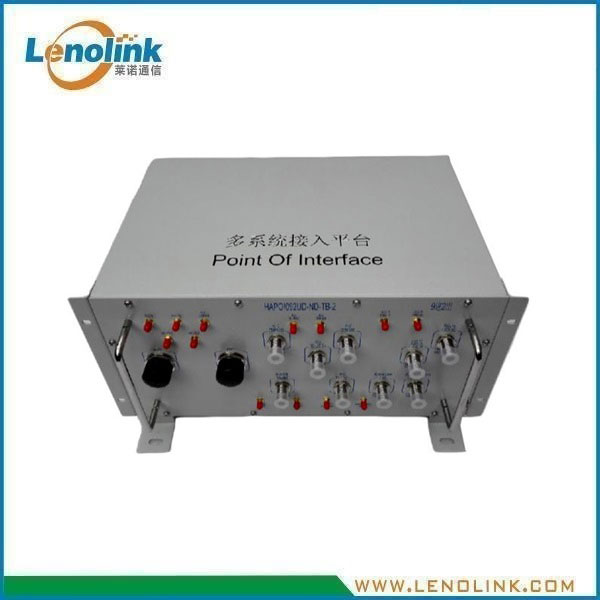
RF POI Manufacturer for 5G DAS Systems | Multi-Operator Point of Interface Combiner
Applications
Model: LC-95.00058
DAS POI is widely used in:
- 5G indoor coverage systems
- Multi-operator mobile networks
- Large public venue DAS
- Enterprise wireless coverage
- Transportation hubs
- Smart buildings
- Designed for high-capacity indoor wireless coverage projects requiring multiple operator integration.
Product Description
Lenolink is a professional RF POI manufacturer in China, providing high-performance passive RF combining and splitting solutions for multi-operator DAS networks.
It enables telecom operators and DAS integrators to combine multiple BTS signals from different frequency bands into a shared antenna infrastructure while maintaining excellent RF isolation and signal integrity.
Supporting 2G, 3G, 4G LTE and 5G networks, the LC-96.00058 integrates high-selectivity filters and duplexers to minimize interference, reduce insertion loss and improve overall system performance.
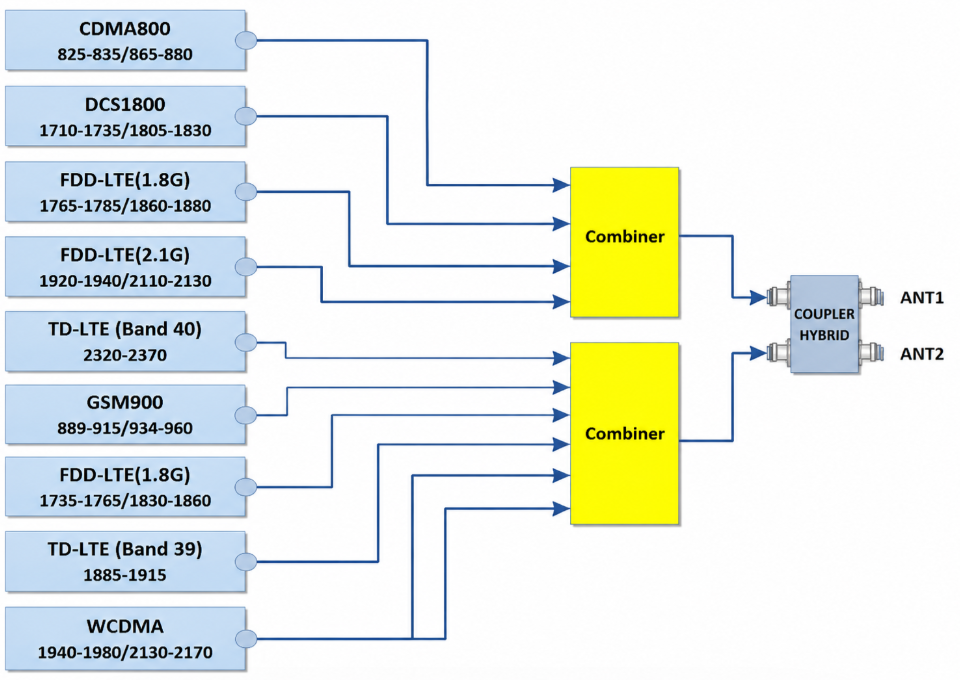
The unit supports up to 9 RF input ports and 2 output ports, making it suitable for large indoor coverage projects including:
- Airports
- Railway stations
- Shopping malls
- Stadiums
- Enterprise buildings
- Public venues
With IP65 protection, 200W input power handling capability, and ≤ -150dBc intermodulation performance, LC-96.00058 delivers reliable RF performance for demanding multi-operator DAS applications.
Key Features
- Supports multi-operator DAS integration
- Compatible with GSM, LTE, TD-LTE, WCDMA and 5G networks
- Up to 9 RF input ports and 2 combined outputs
- High isolation up to 80dB
- Low insertion loss ≤5.0dB
- Low PIM performance ≤-150dBc
- High power handling up to 200W per port
- IP65 protection for demanding environments
- Custom frequency configurations available
5G DAS POI multi operator RF signal combining topology diagram
Product Specifications
Why Choose Lenolink DAS POI Solution?
- Designed for Multi-Operator Networks
Supports integration of multiple telecom operators into a shared DAS infrastructure.
- Engineered for RF Performance
High isolation and low PIM design ensure stable communication quality in dense RF environments.
- Customized RF Engineering
Frequency bands, port configurations, connectors and mechanical structures can be customized according to project requirements.
- Built for Professional DAS Deployment
Suitable for system integrators, telecom operators and indoor coverage contractors worldwide.
Frequently Asked Questions (FAQ)
Q1: What is the main function of a POI (Point of Interface) in a DAS system?
A: A POI conditions, filters, combines, and balances high-power RF downlink signals from multiple telecom operator base stations into a single DAS distribution line, while separating uplink signals back to the base station receivers with high isolation.
Q2: Can model LC-96.00058 be customized for different operator frequencies?
A: Yes. All frequency bands, attenuation levels, port counts, and connector configurations can be fully customized based on local mobile operator specifications.
Q3: How does low PIM (≤ -150 dBc) benefit our wireless network?
A: Low Passive Intermodulation (PIM) prevents unwanted interference signals generated by multiple high-power RF carriers. This keeps the noise floor low, boosting network capacity and throughput for mobile end-users.
Q4: What is the difference between POI and RF combiner?
Compared with a standard RF combiner, a POI is specifically designed for DAS multi-operator integration, providing frequency filtering, signal balancing and high isolation between operators.
Q5: What is a DAS POI used for?
A DAS POI is used to connect multiple mobile operator base stations with a shared distributed antenna system, enabling efficient indoor wireless coverage deployment.
Q6: Can Lenolink provide customized POI solutions?
Yes. Lenolink provides customized RF POI solutions including frequency configuration, port design, mechanical structure and electrical specifications.
Q7: Who uses RF POI equipment?
RF POI equipment is commonly used by telecom operators, DAS contractors, system integrators and wireless infrastructure providers.
Q8: Why choose Lenolink RF POI for DAS deployment?
Lenolink RF POI solutions provide customized frequency configurations, high RF isolation, low PIM performance and flexible mechanical designs to meet telecom operator and DAS integrator requirements.
Q9: What is the difference between DAS POI and DAS combiner?
A DAS POI provides not only RF signal combining but also frequency filtering, isolation management and multi-operator interface functions required for complex DAS deployments.
Request RF POI Solution
Looking for a customized RF POI for your DAS project?
Please provide:
✓ Required frequency bands
✓ Number of operators
✓ Input/output port requirements
✓ Project application
Our RF engineers will provide a customized solution.
Contact: info@lenolink.com