

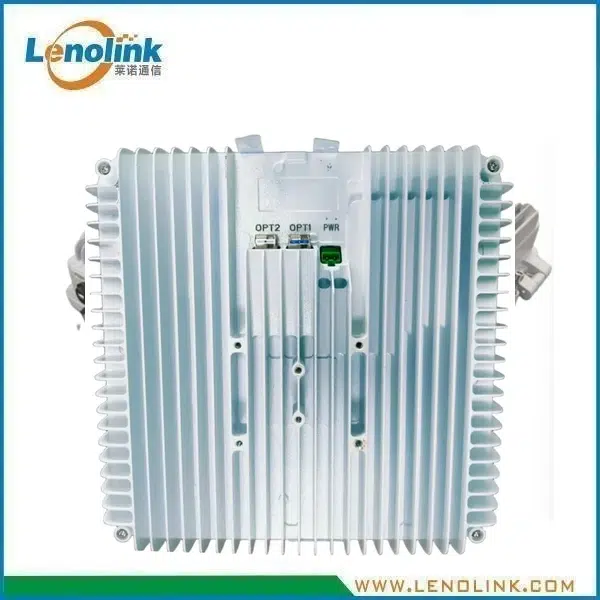
Active/Hybrid DAS (HM-MDAS-AU/EU/RU)
Product Model: HM-MDAS-AU/EU/RU
Applications
Multi-Operator 5G + 4G Indoor Distributed Coverage
The Lenolink Active/Hybrid DAS (model HM-MDAS-AU/EU/RU) is an in-building coverage solution that supports multi-system and multi-service access, based on fiber-optic and network cable carrying wireless signal transmission and distribution. It extends cellular coverage indoors, underground, in tunnels and in other previously unreachable areas.
The system is built on three units — AU (Access Unit), EU (Extend Unit) and RU (Remote Unit) — forming a network of antenna nodes connected to a common radio frequency source through a transport medium that improves both cellular coverage and capacity inside a building. The DAS is open to all wireless carriers.
The specified system supports:
- Five frequency bands: 700 MHz, 900 MHz, 1.8 GHz, 2.1 GHz and 2.6 GHz
- LTE channel bandwidth: 5 / 10 / 15 / 20 MHz
- NR channel bandwidth: 5 / 10 / 15 / 20 / 30 / 40 / 50 / 60 / 70 / 80 / 90 / 100 MHz
- Up to 5 carriers with SISO / 2×2 MIMO / 4×4 MIMO
- Scalable topology: up to 8 EU in star link and up to 12 RU per EU
- 25 Gbps transmission over SFP28 optical interfaces
Typical applications include:
- Large buildings and commercial complexes
- Underground facilities, subways and tunnels
- Airports, railway stations and transportation hubs
- Hospitals, hotels and shopping centers
- Industrial facilities and campus networks
- Multi-operator, multi-band 5G and 4G indoor coverage
Product Summary
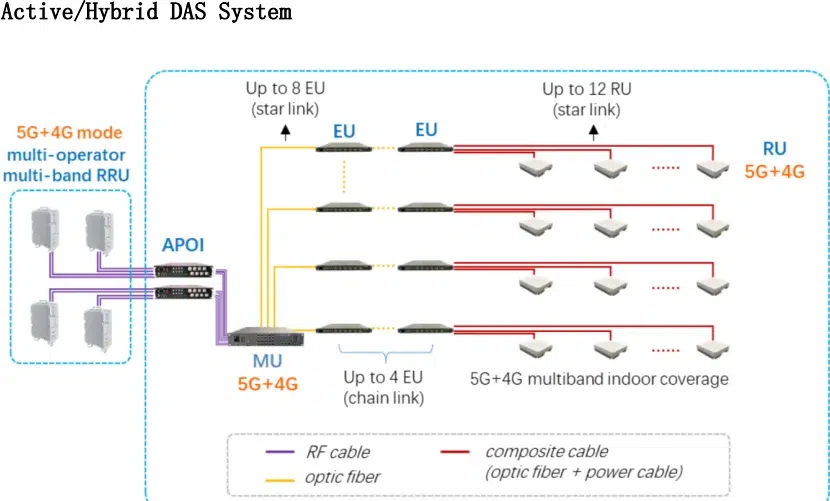
The Lenolink Active/Hybrid DAS distributes RF from the base station or core network to the coverage area through a three-level architecture. The AU obtains the signal from the RRU or core network over optical fiber and sends it to the EU. The EU distributes the signal to multiple RU units, and each RU delivers coverage through a built-in antenna or an external antenna such as a panel antenna.
Generally the AU monitors the whole system and reports all alarm messages to the monitoring center. The RU units are powered by the EU. The AU adopts a standard 1U design and is installed in the equipment room.
The system supports LTE and NR operation across 700 MHz, 900 MHz, 1.8 GHz, 2.1 GHz and 2.6 GHz, with up to 5 carriers and SISO / 2×2 MIMO / 4×4 MIMO channel capacity. Optical transmission between units uses SFP28 interfaces at 25 Gbps.
Typical System Configuration
The diagram below shows the RRU → AU → EU → RU signal distribution of the Active/Hybrid DAS for multi-operator 5G and 4G in-building coverage.
Product Hardware
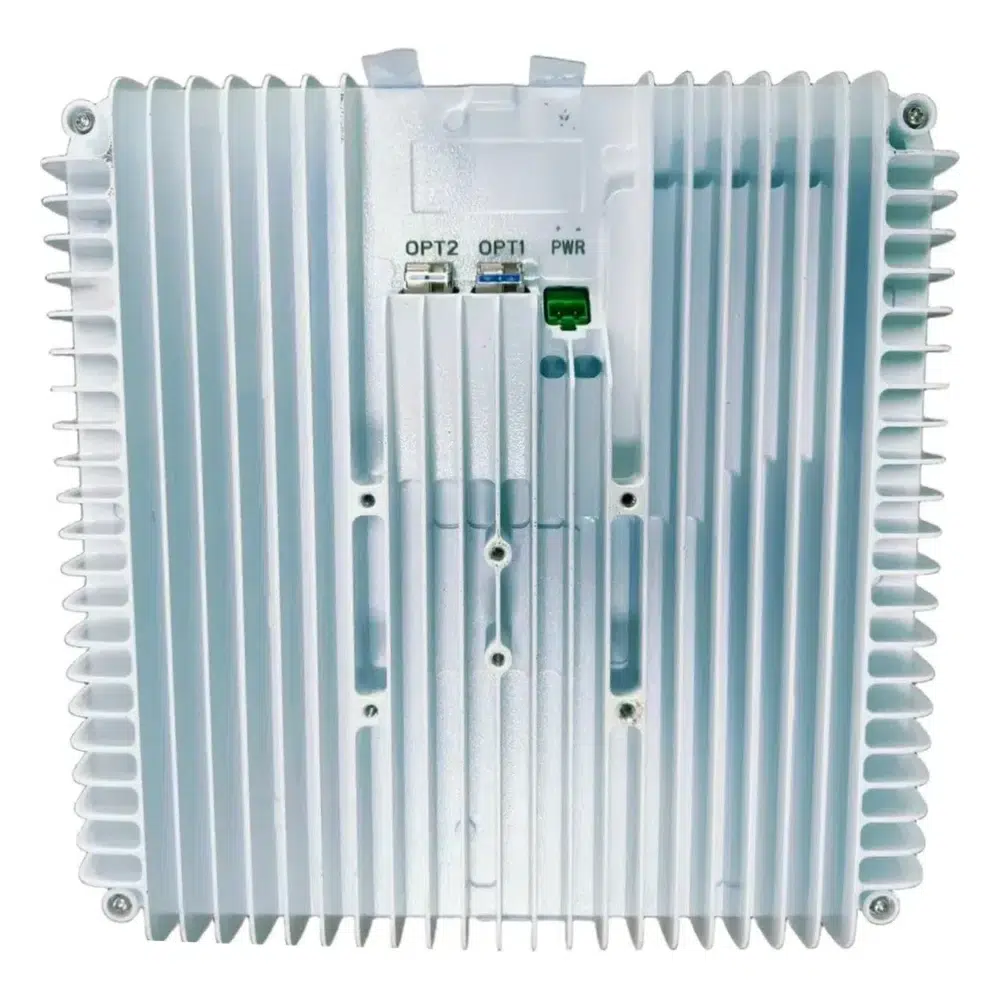
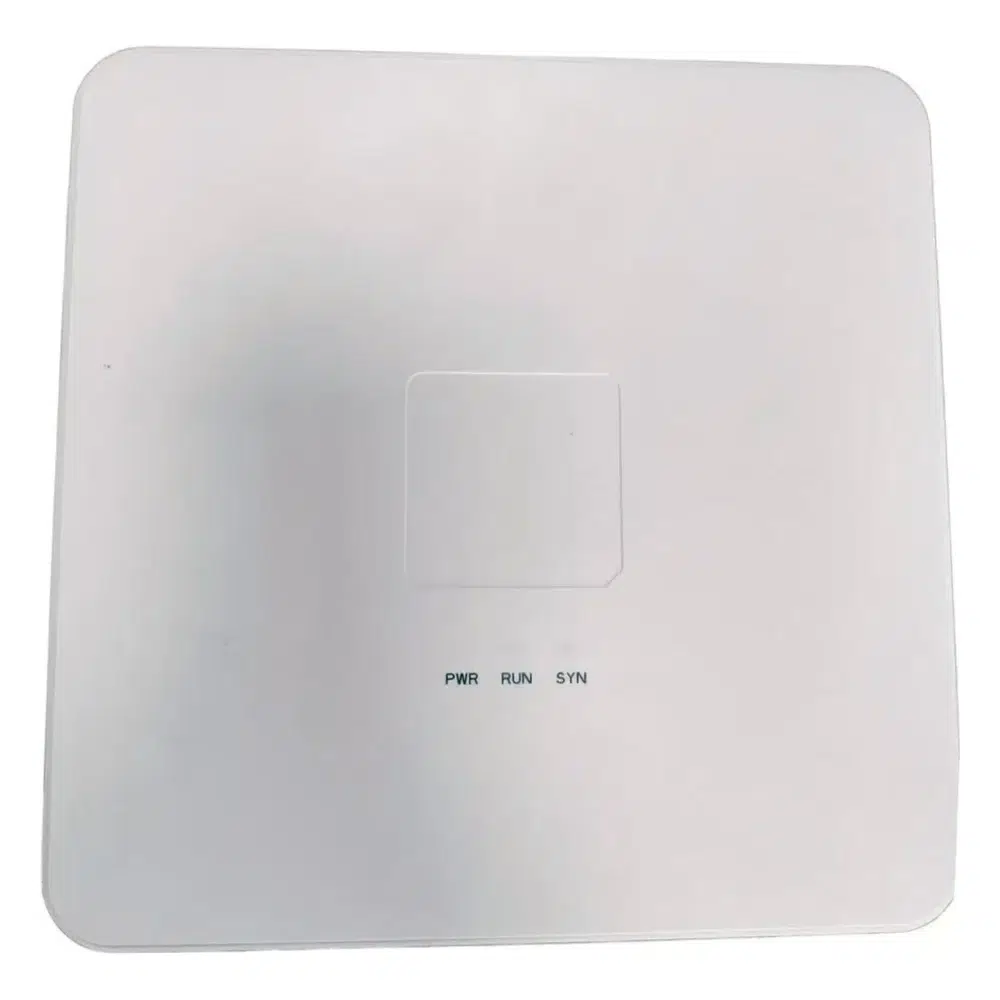
The photos below show the actual Lenolink Active/Hybrid DAS hardware on a clean white background — the optical interface unit with dual SFP ports and power terminal, and the indoor remote panel unit with PWR / RUN / SYN status indicators.
Key Specifications
AU — Access Unit
| Parameter | Specification |
|---|---|
| Product Type | Active/Hybrid DAS Access Unit (AU) |
| Frequency Range | 700M: 703–733 / 758–788 MHz; 900M: 880–915 / 925–960 MHz; 1.8G: 1710–1785 / 1805–1880 MHz; 2.1G: 1920–1980 / 2110–2170 MHz; 2.6G: 2496–2690 MHz |
| Channel Selective | LTE: 5/10/15/20 MHz; NR: 5/10/15/20/30/40/50/60/70/80/90/100 MHz |
| Carrier Selection | Support 5 carriers |
| Channel Capacity | SISO / 2×2 MIMO / 4×4 MIMO |
| Maximum Gain of System | 700M/900M/1.8G/2.1G: 23±3 dB; 2.6G: 25±3 dB (direct coupling); All bands: 85±3 dB (spatial coupling) |
| Upstream Output Power | 700M/900M/1.8G/2.1G: −15 dBm; 2.6G: −17 dBm |
| Maximum Input Power | +15 dBm (direct coupling) |
| Manual Gain Control | 20 dB @ 1 dB/step |
| Delay (AU+EU+RU) | 12 μs |
| Delay Adjustment Range | 50 μs |
| Noise Coefficient (AU+EU+RU) | 10 dB |
| EVM | <5% (64QAM), <2.5% (256QAM) |
| VSWR | 1.6:1 |
| Ripple | 4 dB typical |
| Maintenance Interface | Ethernet RJ45 |
| RF Interface | SMA Female ×3 |
| Transmission Connector | SFP28 ×8 |
| Transmission Rate | 25 Gbps |
| Operating Temperature | −10°C ~ +45°C / 14°F ~ +113°F |
| Maximum Power Consumption | 60 W |
| Ingress Protection Rating | IP25 (Indoor) |
| Equipment Dimensions | 482 × 230 × 44 mm |
| Packaging Dimensions | 505 × 295 × 120 mm |
| Weight | 8.5 kg |
| Power | 100–240V AC, 50/60 Hz | ±48V DC |
| Installation | Wall or 19″ rack |
EU — Extend Unit
| Parameter | Specification |
|---|---|
| Product Type | Active/Hybrid DAS Extend Unit (EU) |
| Transmission Connector | SFP28 ×15 (1 input port) |
| Transmission Rate | 25 Gbps |
| Maintenance Interface | Ethernet RJ45 |
| Power Supply Interface | Phoenix 2pin ×14 |
| Operating Temperature | −10°C ~ +45°C / 14°F ~ +113°F |
| Maximum Power Consumption | 1000 W |
| Ingress Protection Rating | IP25 (Indoor) |
| Equipment Dimensions | 482 × 230 × 44 mm |
| Packaging Dimensions | 505 × 295 × 120 mm |
| Weight | 5 kg |
| Power | 100–240V AC, 50/60 Hz | ±48V DC |
| Installation | Wall |
RU — Remote Unit
| Parameter | Specification |
|---|---|
| Product Type | Active/Hybrid DAS Remote Unit (RU) |
| Frequency Range | 700M: 703–733 / 758–788 MHz; 900M: 880–915 / 925–960 MHz; 1.8G: 1710–1785 / 1805–1880 MHz; 2.1G: 1920–1980 / 2110–2170 MHz; 2.6G: 2496–2690 MHz |
| Channel Selective | LTE: 5/10/15/20 MHz; NR: 5/10/15/20/30/40/50/60/70/80/90/100 MHz |
| Channel Capacity | SISO / 2×2 MIMO / 4×4 MIMO |
| Maximum Gain of System | 700M/900M/1.8G/2.1G: 23±3 dB; 2.6G: 25±3 dB (direct coupling); All bands: 85±3 dB (spatial coupling) |
| Output Power | 21 dBm / 23 dBm / 27 dBm |
| Manual Gain Control | 10 dB @ 1 dB/step |
| EVM | <5% (64QAM), <2.5% (256QAM) |
| VSWR | 1.6:1 |
| Antenna Gain | 4 dBi (low frequency) / 5 dBi (high frequency) |
| Maintenance Interface | Ethernet RJ45 |
| Transmission Connector | SFP28 |
| Operating Temperature | −10°C ~ +45°C / 14°F ~ +113°F |
| Maximum Power Consumption | 80 W |
| Ingress Protection Rating | IP25 (Indoor) |
| Equipment Dimensions | 200 × 200 × 58 mm |
| Packaging Dimensions | 245 × 245 × 135 mm |
| Weight | 3 kg |
| Power | 100–240V AC, 50/60 Hz | ±48V DC |
| Installation | Wall |
Note: Product specifications are based on the current engineering configuration and may be customized according to project requirements.
Key Features
- Photoelectric composite cable / fiber-optic transmission for concealed construction and reduced property coordination
- Pico power design; multiple antennas achieve point / accurate coverage
- RF unit positioned close to users, improving noise figure and system efficiency
- Whole-network monitoring for easier maintenance and higher efficiency
- End-to-end design, easy to adjust, debug and optimize
- Multi-business solution reducing requirements for passive devices
- Support for multi-system, multi-carrier, multi-band and multi-frequency access
- 5G + 4G multi-operator support with up to 5 carriers
- SISO / 2×2 MIMO / 4×4 MIMO channel capacity
- Scalable star topology: up to 8 EU and up to 12 RU per EU
- 25 Gbps SFP28 optical transmission
- Customized products available
Technical Advantages
Fiber and Composite Cable Transmission
The Active/Hybrid DAS uses photoelectric composite cable and fiber-optic transmission. Concealed construction reduces coordination difficulties with property owners, making deployment practical in commercial buildings, tunnels and transportation facilities.
Accurate Point Coverage with Pico Power
Low-power RF units placed close to end users, combined with multiple antennas, achieve point and accurate coverage while improving the noise figure and raising overall system efficiency.
Whole-Network Monitoring
The AU monitors the whole system and reports all alarm messages to the monitoring center. End-to-end design makes the system easy to adjust, debug and optimize, increasing maintenance efficiency.
Multi-Operator and Multi-Band Access
The system supports multi-system, multi-carrier, multi-band and multi-frequency access, covering 700 MHz, 900 MHz, 1.8 GHz, 2.1 GHz and 2.6 GHz for both LTE and NR, and reduces the requirement for passive devices in multi-business deployments.
Flexible Scalable Architecture
The three-level AU / EU / RU architecture supports up to 8 EU in star link, with up to 12 RU per EU in star link, allowing the coverage system to be sized to the building and traffic requirement.
Working Principle
How Does an Active/Hybrid DAS Work?
The system forms a bidirectional distributed antenna network with three functional units.
Downlink
RRU / Core Network → AU → EU → RU → Built-in or external antenna → Coverage Area
Uplink
Coverage Area → Antenna → RU → EU → AU → RRU / Core Network
The AU obtains signals from the RRU or core network via optical fiber and forwards them to the EU. The EU distributes the signal to different RU units. Each RU sends the signal to the coverage area through its built-in antenna or a connected antenna such as a panel antenna. The RU units are powered by the EU, and the AU monitors the whole system and reports alarm messages to the monitoring center.
Why Choose Lenolink Active/Hybrid DAS?
Proven In-Building Coverage
Extends cellular signal indoors, underground, in tunnels and in other previously unreachable areas.
Multi-Operator Ready
Open to all wireless carriers with multi-system, multi-carrier and multi-band access.
5G and 4G Capable
Supports LTE and NR channel bandwidths up to 100 MHz, with SISO / 2×2 / 4×4 MIMO.
Scalable and Customizable
Up to 8 EU and 12 RU per EU, with customized products for project-specific requirements.
Engineering Support
Lenolink RF engineers support system design, configuration, commissioning and troubleshooting.
AU / EU / RU Comparison
| Parameter | Specification |
|---|---|
| AU — Access Unit | Connects to RRU / core network over fiber; 1U 19″ rack; SFP28 ×8, SMA ×3; 25 Gbps; 60 W |
| EU — Extend Unit | Distributes signal to RU units; 1U chassis; SFP28 ×15, Phoenix 2pin ×14; 25 Gbps; 1000 W |
| RU — Remote Unit | Delivers coverage via built-in antenna; wall-mount panel; SFP28; 21/23/27 dBm output; 80 W |
| Common Platform | 700/900/1800/2100/2600 MHz; LTE & NR; up to 5 carriers; SISO/2×2/4×4 MIMO; IP25 indoor |
Frequently Asked Questions
Q1: What is an Active/Hybrid DAS?
An Active/Hybrid DAS is an in-building distributed antenna system that uses fiber-optic and network cable to carry wireless signals from a common RF source to multiple antenna nodes, improving cellular coverage and capacity indoors.
Q2: What units does the Lenolink Active/Hybrid DAS include?
It includes three units: AU (Access Unit), EU (Extend Unit) and RU (Remote Unit).
Q3: Which frequency bands are supported?
The specified configuration supports 700 MHz, 900 MHz, 1.8 GHz, 2.1 GHz and 2.6 GHz.
Q4: Does the system support 5G?
Yes. It supports NR channel bandwidths from 5 MHz up to 100 MHz as well as LTE 5/10/15/20 MHz.
Q5: How many carriers can it handle?
The system supports up to 5 carriers.
Q6: Does it support MIMO?
Yes. It supports SISO, 2×2 MIMO and 4×4 MIMO.
Q7: How many EU and RU units can be connected?
The architecture supports up to 8 EU in star link, and up to 12 RU per EU in star link.
Q8: What is the transmission rate?
The AU and EU use SFP28 optical interfaces with a 25 Gbps transmission rate.
Q9: How is the RU powered?
The RU units are powered by the EU.
Q10: What is the system delay?
The specified delay for AU + EU + RU is 12 μs, with a delay adjustment range of 50 μs.
Q11: What is the maximum gain?
Direct coupling: 23±3 dB for 700M/900M/1.8G/2.1G and 25±3 dB for 2.6G. Spatial coupling: 85±3 dB across all supported bands.
Q12: What is the RU output power?
The RU provides 21 dBm / 23 dBm / 27 dBm output power options.
Q13: What is the ingress protection rating?
All three units are rated IP25 (Indoor).
Q14: Can Lenolink customize the system?
Yes. Lenolink can customize frequency configuration, channel bandwidth, carrier count, MIMO mode, topology, optical interfaces and mechanical design according to project requirements.
Request a Customized Active/Hybrid DAS Solution
Need an Active/Hybrid DAS for your building or tunnel project?
Please provide:
- Required frequency bands and operators
- LTE / NR channel bandwidth requirements
- Number of carriers and MIMO mode
- Coverage area and building layout
- Required number of EU and RU units
- Indoor or outdoor installation
- Power and cabling conditions
Lenolink RF engineers can evaluate the project requirements and provide a customized Active/Hybrid DAS solution.
Contact: [email protected]
